Services for companies and public bodies
Structural Monitoring and Instrumentation of Bridges and Structures
Instrumentation, load testing, operational modal analysis and corrosion monitoring with low-cost sensors developed and validated at UPC BarcelonaTech. For engineering consultancies, contractors, infrastructure owners and public administrations in Spain and the EU.
Why low-cost sensors
Reference-Grade Accuracy at a Fraction of the Cost
What is offered
Four Structural Monitoring Services
Instrumentation and structural monitoring
LARA accelerometers and inclinometers measure vibration and tilt on bridges, footbridges, buildings, walls and heritage structures, in short campaigns or in long-term installations with records spanning several months. Acquisition is time-synchronised across sensors and the hardware is IP67-protected.
Static and dynamic load testing
Instrumentation for bridge load tests: deformations during static tests, natural frequencies and damping during dynamic tests. Validated on the railway access to Barcelona-El Prat airport and in tests with ballast trucks in Barcelona.
Operational modal analysis
Natural frequencies, damping and mode shapes identified from ambient vibration with automated processing, to calibrate numerical models, track how a structure changes and support its assessment. Experience includes drive-through tests on two cable-stayed bridges with Tongji University.
Corrosion monitoring
CORTEX is a UPC device for low-cost, connected corrosion monitoring of steel and reinforced concrete structures. It follows corrosion activity continuously, with remote readings and alerts, to show where and when corrosion is active between inspections, particularly on structures exposed to humid air or de-icing salts. It has been installed alongside LARA inclinometers on a historic steel truss bridge in Catalonia.
Monitoring data can also feed custom dashboards, alerts, AI summaries or decision-support workflows, as in TrackerGuard, structural monitoring for solar trackers in photovoltaic plants.
Field campaigns
Structures in Service Already Instrumented
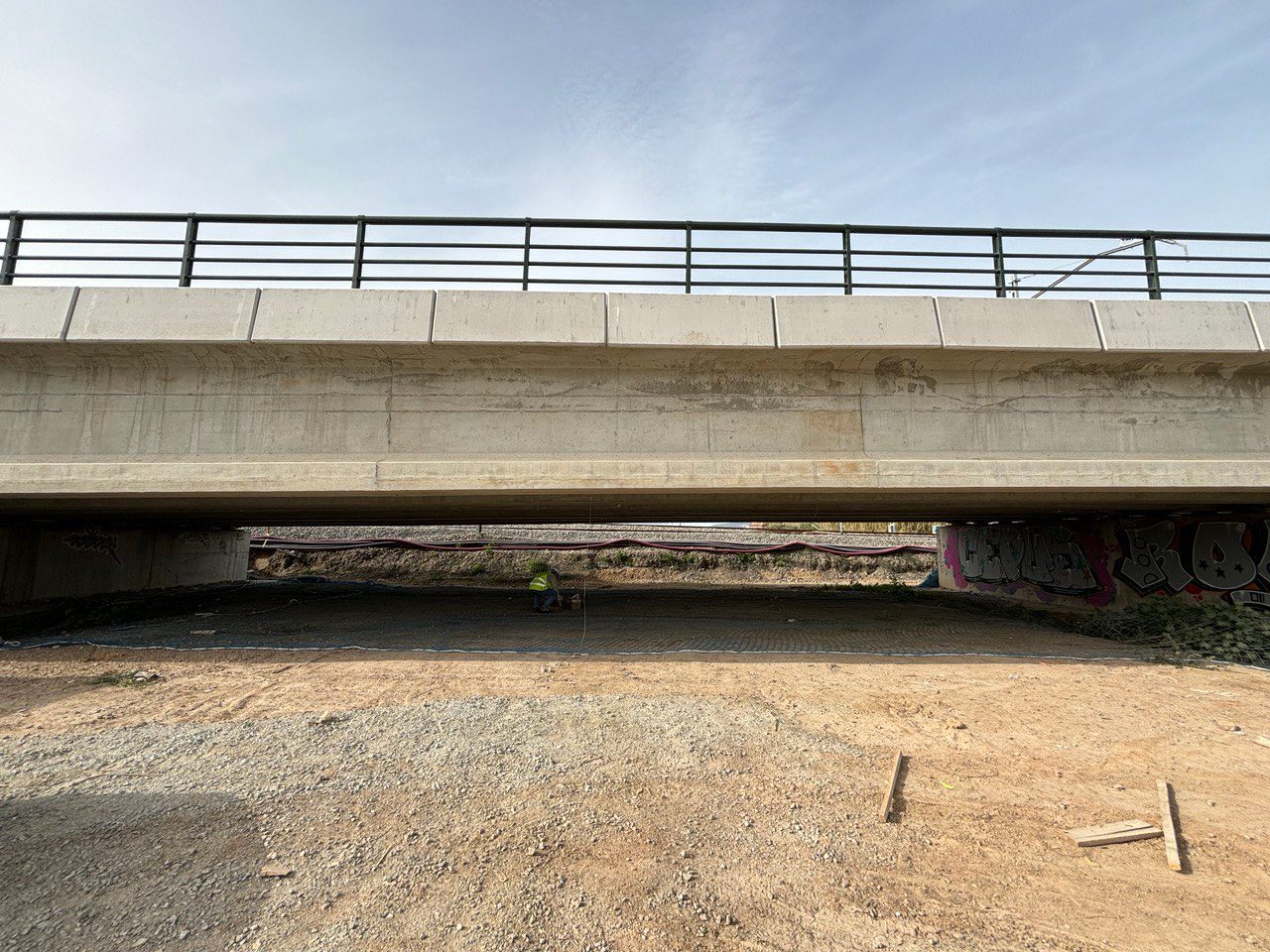
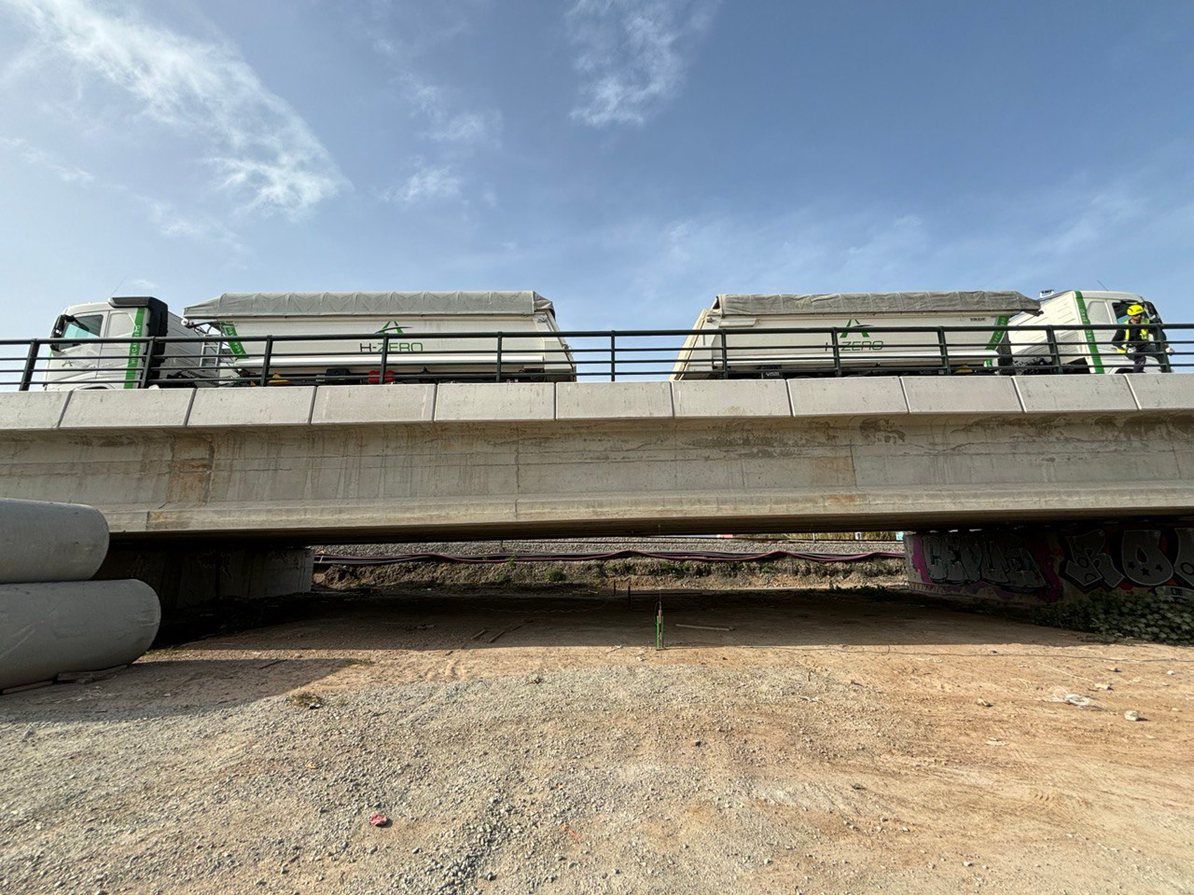
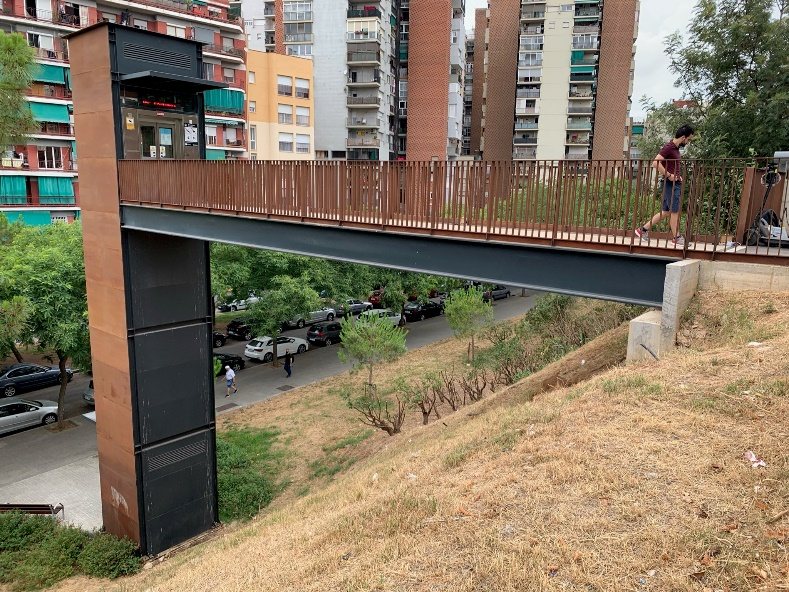
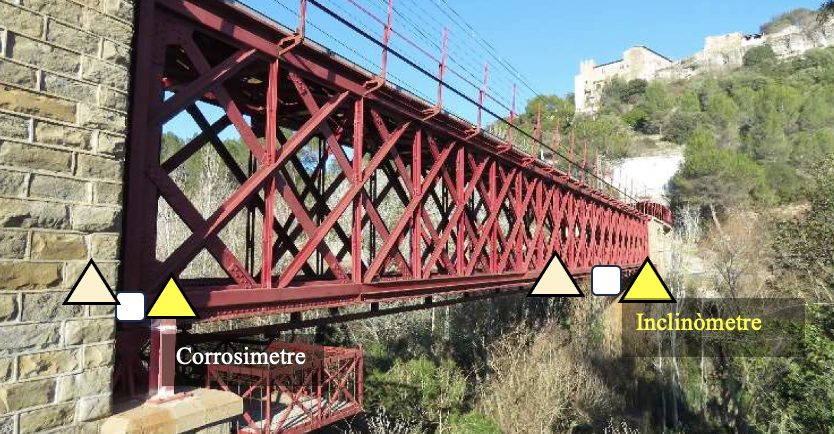
Validation
Checked Against Reference Equipment
Before any structure is instrumented, each device is calibrated on a shaker bench against reference-grade piezoelectric accelerometers (PCB 356B18 and PCB 393A03). The comparison is then repeated on real structures against commercial systems such as HI-INC, DEWE2 and IMI 607A61. On the Polvorín footbridge in Barcelona, LARA matched a commercial HI-INC system across five modes.
Who it is for
For Teams Responsible for Structures
- Engineering consultancies preparing or delivering monitoring and instrumentation contracts that need sensors, analysis or validation.
- Contractors and testing firms carrying out bridge load tests.
- Owners and managers of bridges, railways and roads who want to follow the condition of their structures between inspections.
- Managers of heritage sites, buildings and industrial facilities who need to watch tilt or vibration for months.
- Photovoltaic plants, through structural monitoring of solar trackers.
How we work together
From a First Email to a Contract with UPC
Companies contact me directly. The contract is then made through UPC, so your company contracts with a public university, not with an individual. The route depends on the size of the project.
Contact
Write to me directly with the type of structure, its location, what you need to measure or check and your timeline. A few lines are enough.
Scope
In a first conversation we see whether the case fits best as a research collaboration, a pilot deployment or consulting, and agree what is measured, for how long, with which sensors and what results your team receives.
Contract through UPC
Under 5,000 €, UPC invoices your company on my behalf and receives the payment for the work. From 5,000 € upwards, UPC and your company sign an agreement.
UPC quality control
Both routes, invoice or agreement, carry UPC quality control, whatever the size of the project.
Research group credential. I am a member of ECS, Sustainable Construction Engineering, a UPC research group that holds the TECNIO accreditation awarded by ACCIÓ (Generalitat de Catalunya). TECNIO identifies Catalan entities able to supply technology to companies. The accreditation is held by the group.
Publications
The Research Behind the Service
- Pruebas de Carga Dinámica en Puentes con Sensores de Bajo Costo: Validación en el Acceso Ferroviario al Aeropuerto de Barcelona-El PratIX ACHE International Congress, Granada, 2025
- Evaluación de sensores de bajo coste LARA para la monitorización de deformaciones en puentes durante pruebas de carga estáticaIX ACHE International Congress, Granada, 2025
- Cost-effective bridge health monitoring via automated operational modal analysis using low-cost adaptable and reliable accelerometersStructure and Infrastructure Engineering, 2025
- Application of intelligent low-cost accelerometers for bridge monitoring with a deep learning approachStructural Control and Health Monitoring, 2025
- An innovative drive-through approach for structural testing and experimental insights from two cable stayed bridgesDevelopments in the Built Environment, 2025
- Single drive-by bridge modal frequency identification using multi-sensor data fusionStructures, 2026
Contact
A Structure to Monitor or a Load Test Coming Up?
Send a short description of the structure and what you need. You can write in English, Spanish or Catalan, to Milad.komary@upc.edu.